Cabbage with ham hocks: Calories, Macros, 22 Vitamins & 11 Minerals (USDA Per 100g)
A soulful and comforting Southern classic, cabbage with ham hocks features tender, slow-cooked cabbage infused with the smoky, savory flavor of ham hocks, creating a deeply satisfying side or main dish. --- RECIPE --- Servings: 6-8 Prep Time: 20 minutes (plus ham hock cooking time) Ingredients: - 2 lbs green cabbage, cored and chopped - 1-2 smoked ham hocks - 6 cups water or chicken broth - 1 large onion, chopped - 2 cloves garlic, minced - 1/2 tsp red pepper flakes (optional) - 1 tbsp apple cider vinegar - Salt and black pepper to taste Instructions: 1. In a large Dutch oven or pot, combine ham hocks and water/broth. Bring to a boil, then reduce heat to low, cover, and simmer for 1.5-2 hours, or until ham hocks are very tender. 2. Remove ham hocks from the pot. Let cool slightly, then shred the meat from the bones and discard bones and skin. Set shredded ham aside. 3. Add chopped onion, minced garlic, and red pepper flakes (if using) to the pot with the broth. Bring to a simmer and cook for 5 minutes. 4. Add chopped cabbage to the pot. It may seem like a lot, but it will cook down. Stir to combine. Cover and cook for 20-30 minutes, stirring occasionally, until cabbage is tender. 5. Stir in the shredded ham hock meat and apple cider vinegar. Season with salt and pepper to taste. Serve hot.
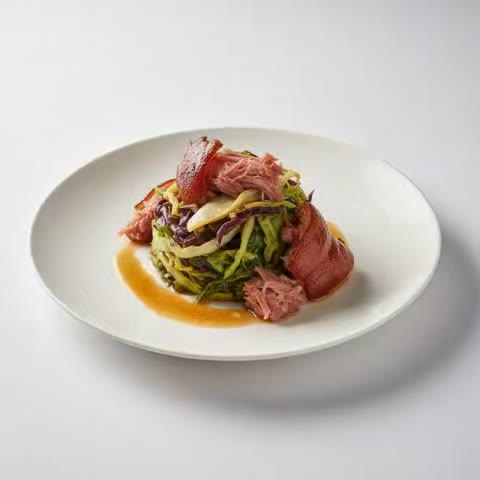
Per 100g reference serving, Cabbage with ham hocks provides 75 kcal of energy, 7.75g protein (42% of calories), 4.9g total carbohydrates (27% of calories, including 1.7g dietary fiber and 2.69g sugars), and 2.58g total fat (31% of calories).
Vitamins Profile in Cabbage with ham hocks (Per 100g)
Track how Cabbage with ham hocks contributes to your daily fat-soluble (Vitamins A, D, E, K), water-soluble B-complex, Vitamin C, Choline, and carotenoid antioxidant targets in Wise Eating: AI Food Tracker.
| Vitamin / Bioactive | Amount per 100g | % Daily Value (FDA DV) |
|---|---|---|
| Vitamin C (Ascorbic Acid) | 23.8 mg | 26.4% DV |
| Vitamin D (D2 + D3) | 0.3 µg | 1.5% DV |
| Vitamin B12 (Cobalamin) | 0.17 µg | 7.1% DV |
| Vitamin A (RAE) | 5 µg | 0.6% DV |
| Vitamin E (Alpha-Tocopherol) | 0.2 mg | 1.3% DV |
| Vitamin K (Phylloquinone) | 41.2 µg | 34.3% DV |
| Vitamin B1 (Thiamin) | 0.184 mg | 15.3% DV |
| Vitamin B2 (Riboflavin) | 0.108 mg | 8.3% DV |
| Vitamin B3 (Niacin) | 2.23 mg | 13.9% DV |
| Vitamin B6 (Pyridoxine) | 0.222 mg | 13.1% DV |
| Total Folate (Vitamin B9) | 26 µg | 6.5% DV |
| Folate (Dietary Folate Equivalents) | 26 µg | 6.5% DV |
| Natural Food Folate | 26 µg | 6.5% DV |
| Choline | 35.3 mg | 6.4% DV |
| Preformed Retinol | 2 µg | 0.2% DV |
| Beta-Carotene | 28 µg | 0.8% DV |
| Alpha-Carotene | 22 µg | 1.8% DV |
| Lutein + Zeaxanthin | 20 µg | 0.2% DV |
Minerals & Electrolytes in Cabbage with ham hocks (Per 100g)
Electrolyte ratios (potassium-to-sodium, calcium-to-magnesium) and trace minerals (iron, zinc, selenium, copper, manganese) determine cellular hydration, oxygen transport, and thyroid function.
| Mineral / Electrolyte | Amount per 100g | % Daily Value (FDA DV) |
|---|---|---|
| Iron (Fe) | 0.43 mg | 2.4% DV |
| Calcium (Ca) | 32 mg | 2.5% DV |
| Magnesium (Mg) | 17 mg | 4% DV |
| Potassium (K) | 255 mg | 5.4% DV |
| Zinc (Zn) | 0.89 mg | 8.1% DV |
| Selenium (Se) | 9.3 µg | 16.9% DV |
| Phosphorus (P) | 106 mg | 8.5% DV |
| Copper (Cu) | 0.052 mg | 5.8% DV |
| Sodium (Na) | 344 mg | 15% DV |
Fatty Acids, Omega-3s & Sterols (Per 100g)
| Lipid / Fatty Acid | Amount per 100g | % Reference Target |
|---|---|---|
| Omega-3 ALA (Alpha-Linolenic Acid) | 0.014 g | 0.9% DV |
| Linoleic Acid (Omega-6 PUFA) | 0.298 g | 2.1% DV |
| Monounsaturated Fat (MUFA) | 1.08 g | 3.6% DV |
| Polyunsaturated Fat (PUFA) | 0.347 g | 1.7% DV |
| Saturated Fat (SFA) | 0.812 g | 4.1% DV |
| Dietary Cholesterol | 20 mg | 6.7% DV |
Essential Amino Acids & BCAAs (Per 100g)
| Amino Acid | Amount per 100g | % Daily Reference |
|---|---|---|
| Trace / Not significant per 100g serving | ||
Related USDA Foods to Compare
Frequently Asked Questions
100 grams of Cabbage with ham hocks contains 75 calories (kcal), 7.75g of protein, 4.9g of carbohydrates (1.7g fiber, 2.69g total sugars), and 2.58g of total fat according to the USDA Standard Reference dataset in Wise Eating.
Cabbage with ham hocks has an estimated food pH of 6 and a Potential Renal Acid Load (PRAL) score of 1.51 mEq/100g, classifying it as Acid-Forming (Positive PRAL).
Allergen tags for Cabbage with ham hocks: None of the Top 9 major allergens. In Wise Eating's WHO-aligned pediatric feeding database, the minimum age guideline is 8+ months with age-appropriate preparation.
Download Wise Eating: AI Food Tracker (App Store ID 6751406823) to log Cabbage with ham hocks by voice, barcode, photo, or search, and automatically calculate your daily 22 vitamins, 11 minerals, amino acids, and omega-3 fatty acids.